
Q1.You are using the Azure Video Indexer service to provide an internal video search interface on your company website.
You need to enable viewers to search for videos based on who appears in them.
How should you configure this?
Show answer
Azure AI Video Indexer (formerly Azure Media Services Video Indexer) provides the ability to detect and identify people’s faces in videos.
To make a specific person searchable, you need to create a person model in your account and train that model to recognize faces.
When you specify the person model ID during video upload or re-indexing, Video Indexer uses that custom person model to identify people.
Assigning a name to a face adds the person’s information to the model, so the same person is recognized in later and earlier videos as well.
Option B works differently, options C and D are unrelated to person search, and the language model in option E is not related to person identification.
Customize a Person model with the Video Indexer API
Q2.You are creating a web app app1 that runs on Azure virtual machine vm1.
vm1 is deployed in Azure virtual network vnet1.
You plan to create a new Azure Cognitive Search service service1.
You need to ensure that app1 can connect directly to service1 without going through the public internet.
Solution: You deploy service1 with a public endpoint and configure IP firewall rules.
Does this meet the goal?
Show answer
IP firewall rules are merely a feature that restricts the source IPs allowed to access Azure AI Search.
The communication itself goes through the public endpoint, so the traffic travels over the internet.
Therefore, it cannot satisfy the requirement to connect without going through the public internet.
To meet the requirement, you need to create a private endpoint with Azure Private Link and connect via a private IP within the virtual network.
Note that Azure Cognitive Search has now been renamed to Azure AI Search.
Create a private endpoint for Azure AI Search
Q3.You are building a chatbot that uses the GPT-3.5 model in Azure OpenAI.
You need to improve the quality of the chatbot’s responses.
The solution must minimize development effort.
Which two methods achieve the goal?
Each answer presents a complete solution.
Show answer
To improve the response quality of an Azure OpenAI chatbot quickly, improving prompt design rather than retraining the model is effective.
Providing grounding content is a technique that references external data to increase accuracy, and it is commonly implemented as RAG (Retrieval-Augmented Generation).
This enables answers based on your own data and reduces incorrect responses.
In addition, few-shot prompting, which includes sample request and response pairs, shows the model the desired answer format and improves quality.
Fine-tuning, retraining the model, and building a custom LLM require significant effort and conflict with the requirement to minimize it.
Prompt engineering techniques
Q4.You have an Azure subscription that contains an Azure AI Language resource Resource1.
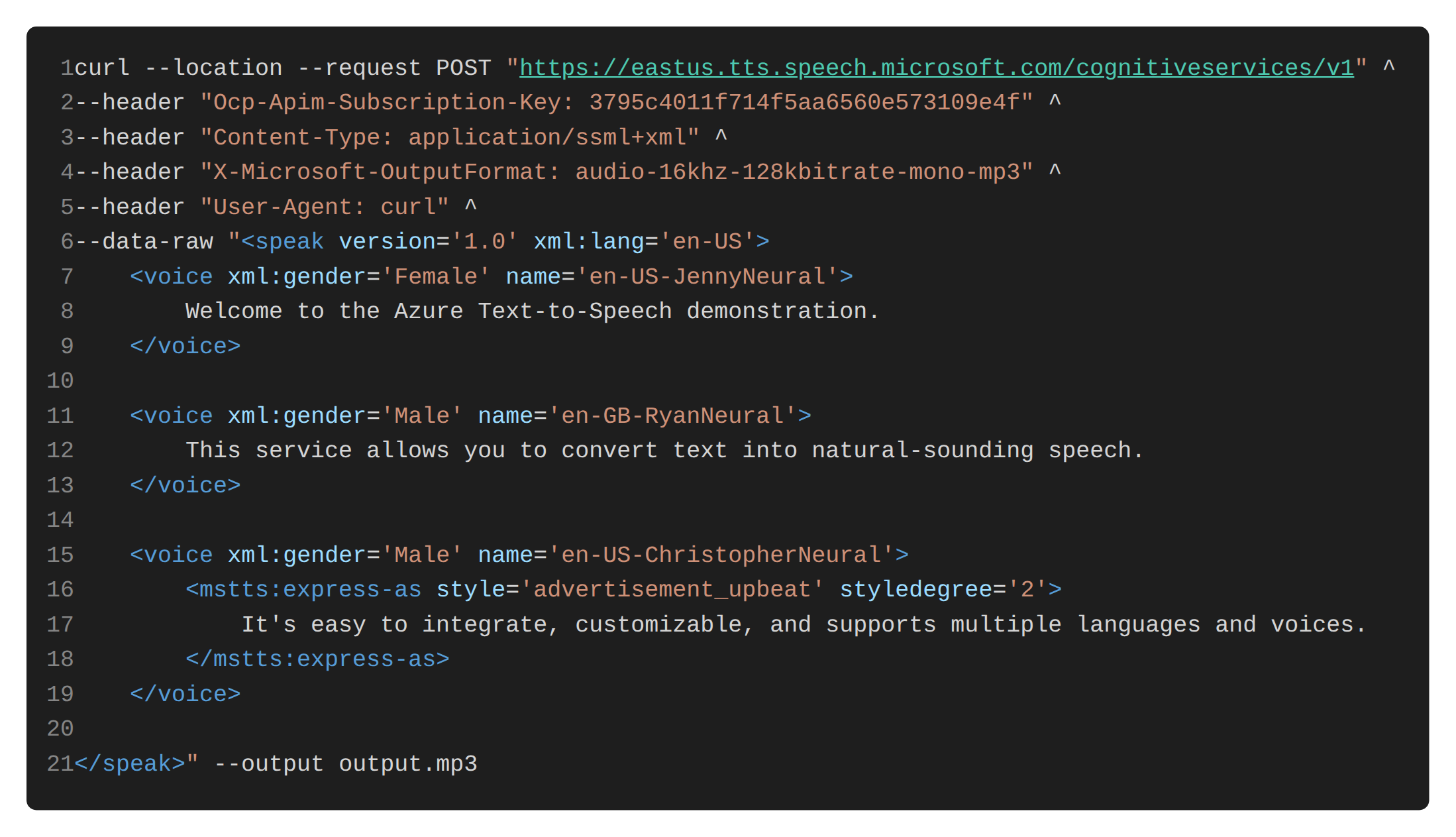
You run the following cURL command and play the Output.mp3 file.
In the SSML that the command sends, the first voice en-US-JennyNeural (female) reads “Welcome to the Azure Text-to-Speech demonstration.”, the second voice en-GB-RyanNeural (male) reads “This service allows you to convert text into natural-sounding speech.”, and the third voice en-US-ChristopherNeural (male, mstts:express-as style=advertisement_upbeat) reads “It’s easy to integrate, customizable, and supports multiple languages and voices.”
For each of the following statements, select “Yes” if it is true and “No” if it is not.
| Statement | Yes | No | |
|---|---|---|---|
| You can hear each of the three sentences in a different voice | |||
| You can hear each of the three sentences in a different accent | |||
| All three sentences are read in a neutral tone |
Show answer
This SSML contains three voice elements, each specifying a different voice model.
en-US-JennyNeural, en-GB-RyanNeural, and en-US-ChristopherNeural are separate voice models, so the text is read in three different voices.
Regarding accents, however, two are US English and one is British English, so not all three have different accents.
The third voice specifies mstts:express-as style=advertisement_upbeat, giving it a bright, advertisement-style delivery.
Therefore, not all of the sentences are read in a neutral tone.
Speech Synthesis Markup Language (SSML) overview
Q5.You are developing an app that uses the Azure AI Speech service.
You need to enable the app to authenticate to the service using a Microsoft Entra ID token.
Which two actions should you perform?
Each answer presents part of the solution.
Show answer
When using Microsoft Entra ID token authentication with Azure AI Speech, you need to configure a custom subdomain for the resource.
A custom subdomain creates a service-specific endpoint URL and enables authentication with an Entra ID token.
In addition, the Speech resource requires a private endpoint configuration.
A private endpoint lets you connect securely from the virtual network and supports Entra ID authentication.
Conditional access controls user access, and X.509 certificates and virtual network service endpoints are not requirements for this authentication.
Role-based access control for the Azure AI Speech service
Q6.You are building a multilingual chatbot.
You need to return different responses for positive and negative messages.
Which two Text Analytics APIs should you use?
Each answer presents part of the solution.
Show answer
For the chatbot to give different responses for positive and negative messages, you first need to determine the sentiment of the user’s text.
Azure AI Language sentiment analysis classifies text as positive, negative, or neutral and returns the result together with confidence scores.
This lets you implement response handling based on sentiment.
Also, because the input language may be unknown in a multilingual scenario, you need to identify the language of the text with the language detection API.
By identifying the language first and then performing sentiment analysis, sentiment can be determined across multiple languages.
Note that the Text Analytics API is now provided as part of Azure AI Language.
What is sentiment analysis and opinion mining?
Q7.You are building an app using Semantic Kernel.
The app’s prompt template needs to include complex objects.
The solution must support objects that have sub-properties.
Which two prompt templates can you use?
Each answer presents a complete solution.
Show answer
To pass complex data structures into prompts in Semantic Kernel, a template engine expands object properties and collections.
Both Liquid and Handlebars are template languages that support referencing sub-properties of nested objects, conditional branching, and loops.
Therefore, they are suitable for embedding complex objects.
JSONL, on the other hand, is a dataset format and not a template language.
YAML is a format for configuration and data definition and has no template processing capability.
Semantic Kernel itself is a framework, not a template language, so it is not appropriate.
Semantic Kernel prompt template syntax
Q8.You are building a bot using the Microsoft Bot Framework.
You need to configure the bot so it can respond to voice requests.
The solution must minimize development effort.
What should you do?
Show answer
To handle voice requests with minimal development effort, deploying the bot to Azure and registering it with the Direct Line Speech channel is the appropriate approach.
Direct Line Speech is a voice-enabled channel that handles both recognition of voice input and synthesis of voice responses in an integrated way, letting you configure a voice bot without implementing additional speech-processing code.
Integrating with Cortana via the Bot Framework SDK is no longer available because the Cortana Skills Kit has been retired.
Building voice processing through Azure Functions requires custom implementation and increases effort.
The Microsoft Teams channel is primarily for text-based interaction and is not suited to the voice requirement.
Connect a bot to Direct Line Speech
Q9.You have an Azure subscription that contains a Microsoft Foundry hub Hub1, an Azure OpenAI resource resource1, and a user User1.
You need to enable User1 to create a new Azure Content Understanding in Foundry Tools project in Hub1.
The solution must follow the principle of least privilege.
Which role should you assign to User1?
Show answer
To create a project that uses Azure OpenAI in Microsoft AI Foundry, the user needs permission to use the Azure OpenAI resource.
The Cognitive Services OpenAI User role provides the minimum permissions needed to use Azure OpenAI models and endpoints.
By assigning this role, the user can use the Azure OpenAI resource from Azure AI Foundry tools to create a project.
The Cognitive Services OpenAI Contributor and Azure AI Administrator roles, on the other hand, include resource management permissions and violate the principle of least privilege.
Therefore, Cognitive Services OpenAI User, which grants only the minimum necessary permissions, is appropriate.
Role-based access control for Azure OpenAI Service
Q10.You are developing a call to the Face API.
This call needs to search for similar faces from an existing list named employeefaces.
The employeefaces list contains 60,000 images.
How should you write the body of the HTTP request?
Show answer
When storing 60,000 face images with the Face API, you use largeFaceListId rather than the regular faceListId.
This is because a Face List supports up to 1,000 faces, whereas a Large Face List supports up to 1,000,000 faces.
Therefore, LargeFaceListId is the correct answer for blank 1.
Also, the appropriate value to specify for mode is matchFace.
matchFace is a mode that searches for the face most similar to the input face and is used for one-to-one similarity search.
matchPerson, on the other hand, is intended to broadly search for candidates who are the same person, so it is not suitable for blank 2.
Find similar faces